Research
Models & Algorithms for Social Networks
Twitter data, community detection, and understanding how people exchange information online.
Social networking applications generate terabytes of data daily, offering a unique window into how people interact and exchange information. As an ROP student, I had the privilege of researching social networks alongside Professor Peter Marbach. Together we discovered fascinating characteristics within communities formed on Twitter — and I continued the work into a research project course in summer 2022.
Findings during 2021–2022 (ROP)
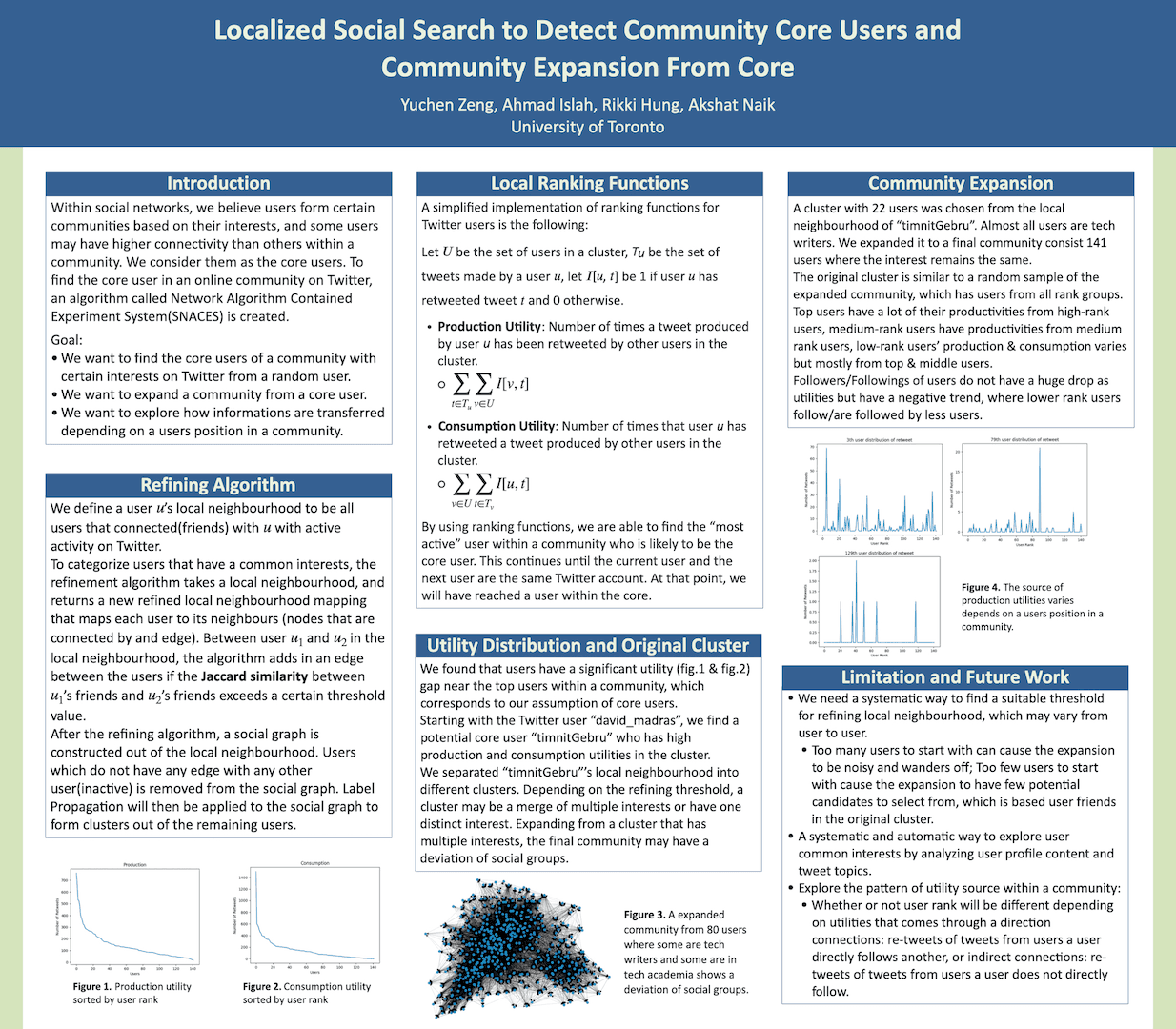
In social networks, communities form around shared interests. Some users — "core users" — exhibit higher connectivity than others. To identify them on Twitter, we built the Network Algorithm Contained Experiment System (SNACES). Given a random user, SNACES finds their local neighborhoods, clusters users, and ranks them to identify the most connected individual. The process repeats until SNACES converges on a single user.
Goals & metrics
- Community core: starting from a random user, find the core members of their community.
- Community expansion: from core users, expand to map the broader community structure.
- Production: retweets a user's original tweets receive from others in the community.
- Consumption: retweets the user makes of others' original tweets in the community.